mercredi 31 mai 2017

What is Flammarion's Wood Cut Doing Illustrating a CMI Article on Galileo?


Back in October 1997, Russell Grigg published an article on Galileo.

It finishes with, just before the notes, a fact box about the Ptolemaic system.

One could of course ask what such a fact box is doing there, since the Church was in 1616 and 1633 very much not defending the integral Ptolemaic system, but only two of its data in common with other Geocentric and Geostatic systems: 1) Sun moves around Earth daily and 2) moves its daily movement around Earth from South to North and back across Equator yearly.

In fact, the Church was supporting astronomers like Riccioli, who thought that Almagest needed an update badly, because Ptolemy was wrong on so many things, hence the title of Riccioli's work Almagestum Novum. Discoveries by Tycho Brahe and Kepler were taken into account, while two positions (not discoveries) by Kepler were rejected:

  • that Earth moves in a yearly orbit around the Sun and also in a daily rotation around itself*;
  • that the mechanism of movements of celestial bodies is mechanistic.**


But there is another twist to this. Using Flammarion's woodcut when talking of Ptolemaic system is a somewhat dishonest bait and switch tactic. And here is alas what I saw on the article:


Can we get a little close up of the illustration to the right? Here:
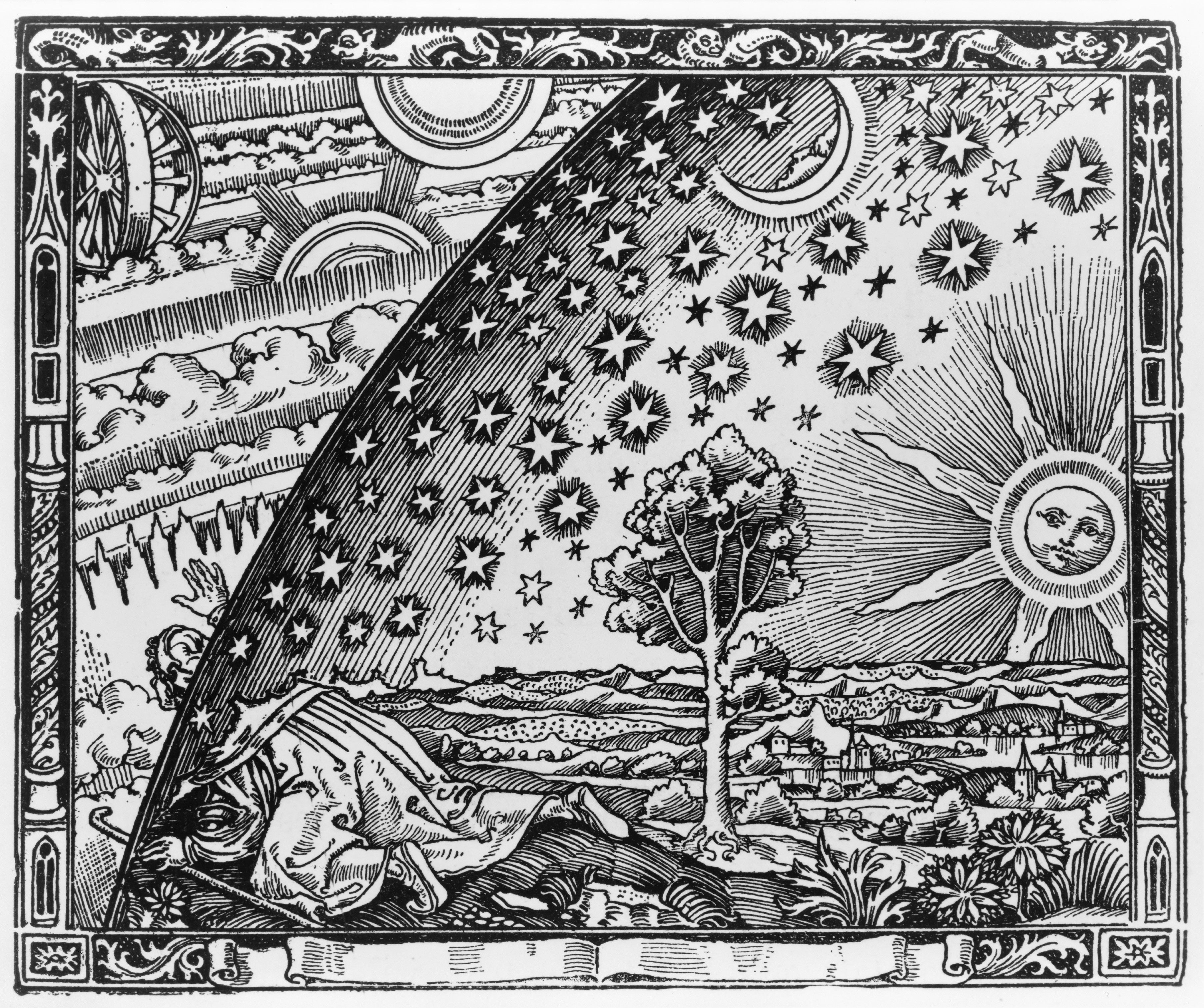
A traveller puts his head under the edge of the firmament in the original (1888) printing of the Flammarion engraving.
Anonymous - Camille Flammarion, L'Atmosphère: Météorologie Populaire (Paris, 1888), pp. 163

The Flammarion engraving is a wood engraving by an unknown artist that first appeared in Camille Flammarion's L'atmosphère: météorologie populaire (1888). The image depicts a man crawling under the edge of the sky, depicted as if it were a solid hemisphere, to look at the mysterious Empyrean beyond. The caption underneath the engraving (not shown here) translates to "A medieval missionary tells that he has found the point where heaven and Earth meet..."

Image and captions from:

https://en.wikipedia.org/wiki/Flammarion_engraving#/media/File:Flammarion.jpg


OK, if we go to the mere text in the fact box by Russell Grigg, there is no indication whatsoever that Ptolemaic world view involves a place where heaven and earth meet, like in the wood cut or engraving. Nor any other indication that a Ptolemy reader, believing what he read, would be involved in Flat Earth. Precisely as in the fact text by Flammarion.

In the illustration, however, there is a very clear suggestion that, as there was in Medieval times (it looks like a Medieval wood cut, except it is not clumsy enough***!) a kind of imagination around of a place where heaven and earth met, there was also a kind of imagination that Earth was flat, rather than a globe surrounded by Heaven on all sides. While no actual word, only the fact it is given as illustration of other words, suggests this was a part of Ptolemaic world view, nothing stops the reader (especially the lazy reader, taking things in as a unity) from making the association and actually believing this.

Is Russell Grigg unaware that the original illustration by Flammarion was also given a caption much more directly misleading, one saying basically that the Medievals were willing to believe a Catholic missionary on such detail? If not, and if he is an honest person, rather than as some Ian Paisley creatures willing to twist facts to get at the Catholic Church, why did he include the illustration? Was someone else doing so on the CMI staff?

And if he was not aware of this ulterior dishonesty, even so, why include the wood cut at all, since obviously it was not about the Ptolemaic world view at all?

Was he sentimental about old school books, or did he lose the sense of relevance? I mean, even if he is now one of the older guys on CMI, or even retired, back then he was just 70 years, and people who live to ninety don't tend to be Alzheimer patients, so I can't believe that. However, he could have been a wee bit too faithful to some of the less honest teachers he had met in his childhood or teens or young carreer as a chemist, at university or after.

He is perhaps not the only chemist, who, while learning useful things about chemistry, learned useless things about History of Science.

Hans Georg Lundahl
Nanterre UL
Wednesday of
Pentecost Novena
31.V.2017

Notes:

* Riccioli, like the Church, said probably : definitely wrong - but I have not read that passage, I have not read the whole work. ** Riccioli, in absence of definition by the Church but in presence of a preponderance in favour of angelic movers among writers of the Church considered Kepler probably wrong. That particular passage I have read. I quoted it in this article:

New blog on the kid : What Opinion did Riccioli call the Fourth and Most Common One?
http://nov9blogg9.blogspot.com/2014/08/what-opinion-did-riccioli-call-fourth.html


Written in response to Sungenis and DeLano who while fellow Catholics and fellow Geocentrics were more on Kepler's than on Riccioli's side when it comes to angelic movers.

*** The level of technique in wood cuts shown in this one would be that acquired by the time of the Reformers or even later - after Magellan had settled the issue.

Update:

On Facebook:

Hans-Georg Lundahl
Actually, I just detected a place where Russell Grigg was using a fraudulent or fraudulently placed illustration too: [linking here]

Creation Ministries International
Hans-Georg Lundahl: Links outside of creation.com aren't allowed (our rules on our main Facebook page explain why). You can re-post in fresh thread without the link. As per rule #7, comment hidden.

Hans-Georg Lundahl
My article was my argument fleshed out.

Feel free to just forward it to him.

I have given him an opportunity to respond.


[I was then given and used a good method of forwarding.]

PS : It seems that the article was changed in response to this request. It seems also that the article was changed from a magazine October 1997 to one in September 1997.

lundi 29 mai 2017

Interim III, Flood to Abraham with Syncellus


Tas Walker and Myself on C14 : Glacial Maximum and End · Interim III, Flood to Abraham with Syncellus · Continuing Interim III to Joseph in Egypt · Comparing Three Roads from Seven Cows to Seven Trumpets

We make a little chart according to Peleg synchronised with Babel and Abraham in En-Geddi with Chalcolithic thereof.

Peleg 529 - 868, Abraham 1070 – 1245, in each case, after the Flood.

Longevity Charts as per LXX
http://creavsevolu.blogspot.com/2015/11/longevity-charts-as-per-lxx.html


Babel's City starts getting built : 5 years after Peleg was born, 534 after Flood.

Dispersion of Languages, building of the City ceases : 40 years later, 574 after Flood.

Abraham in En-Geddi, 80 years after Birth; 1150 after Flood.

  • This chart is non-St Jerome, I will be treating this as Syncellus.

    5500 Creation BC
    2242 Flood Anno Mundi
    3358 Flood BC

    3358 BC
    0534 Babel begins
    2824 BC

    3358 BC
    0578 Babel ends
    2780 BC

    3358 BC
    1150 Abraham in En-Geddi
    2208 BC

  • Archaeological identifications of Flood, Babel and Abraham in En-Geddi, with the carbon dates:

    • Displacement of Neanderthals by Cro-Magnon in Europe (40 000 BP).

      40 000 BP =
      38 000 BC carbon
      03 358 BC real
      34 642 extra years

    • Göbekli Tepe (9600 - 8600 BC)

      9600 BC carbon
      2824 BC real
      6776 extra years

      8600 BC carbon
      2780 BC real
      5820 extra years

    • Chalcolithic of En-Geddi (3400 BC)

      3400 BC carbon
      2208 BC real
      1192 extra years


  • In detail

    • Flood to Babel

      3358
      2824
      0534/13=41.0769230769230769

      I 3358 II 3317 III 3276
      IV 3235 V 3194 VI 3153
      VII 3112 VIII 3070 IX 3029
      X 2988 XI 2947 XII 2906
      XIII 2865 XIV 2824


    • Extra years therein:

      34 642
      06 776
      27 866/13=2143.5384615384615385

      I 34 642 II 32498 III 30355
      IV 28211 V 26068 VI 23924
      VII 21781 VIII 19637 IX 17494
      X 15350 XI 13207 XII 11063
      XIII 8920 XIV 6776


    • Babel to Chalcolithic En-Geddi

      2780
      2208
      0572/14=40.8571428571428571

      XV 2780 XVI 2739 XVII 2698
      XVIII 2657 XIX 2617 XX 2576
      XXI 2535 XXII 2494 XXIII 2453
      XXIV 2412 XXV 2371 XXVI 2331
      XXVII 2290 XXVIII 2249 XXIX 2208


    • Extra years therein:

      5820
      1192
      4628/14=330.5714285714285714

      XV 5820 XVI 5489 XVII 5159
      XVIII 4828 XIX 4498 XX 4167
      XXI 3837 XXII 3506 XXIII 3175
      XXIV 2845 XXV 2514 XXVI 2184
      XXVII 1853 XXVIII 1523 XXIX 1192


    • Apparent years:

      I 38 000 BC II 35 815 BC III 33 631 BC
      IV 31 446 BC V 29 262 BC VI 27 077 BC
      VII 24 892 BC VIII 22 708 BC IX 20 523 BC
      X 18 338 BC XI 16 154 BC XII 13 969 BC
      XIII 11 785 BC XIV 9600 BC XV 8600 BC
      XVI 8229 BC XVII 7857 BC XVIII 7486 BC
      XIX 7114 BC XX 6743 BC XXI 6371 BC
      XXII 6000 BC XXIII 5629 BC XXIV 5257 BC
      XXV 4886 BC XXVI 4514 BC XXVII 4143 BC
      XXVIII 3771 BC XXIX 3400 BC


    • Pmc as per atmospheric level

      I 1.514 II 1.962 III 2.543
      IV 3.295 V 4.271 VI 5.535
      VII 7.173 VIII 9.297 IX 12.049
      X 15.616 XI 20.239 XII 26.23
      XIII 33.994 XIV 44.057 XV 49.459
      XVI 51.476 XVII 53.577 XVIII 55.763
      XIX 58.038 XX 60.405 XXI 62.87
      XXII 65.435 XXIII 68.105 XXIV 70.883
      XXV 73.775 XXVI 76.785 XXVII 79.918
      XXVIII 83.178 XXIX 86.572


Let's make a table, inserting the patriarchs from the longevity chart?

I 3358 BC
1.514 pmc 38 000 BC

Arphaxad *
3356 BC

II 3317 BC
1.962 pmc 35 815 BC

III 3276 BC
2.543 pmc 33 631 BC

IV 3235 BC
3.295 pmc 31 446 BC

Cainan *
3223 BC

V 3194 BC
4.271 pmc 29 262 BC

VI 3153 BC
5.535 pmc 27 077 BC

VII 3112 BC
7.173 pmc 24 892 BC

Shelah *
3093 BC

VIII 3070 BC
9.297 pmc 22 708 BC

IX 3029 BC
12.049 pmc 20 523 BC

Noah +
3008 BC

X 2988 BC
15.616 pmc 18 338 BC

Eber *
2963 BC

XI 2947 BC
20.239 pmc 16 154 BC

XII 2906 BC
26.23 pmc 13 969 BC

XIII 2865 BC
33.994 pmc 11 785 BC

Shem +
2858 BC

Peleg *
2829 BC

XIV 2824 BC
44.057 pmc 9600 BC

Arphaxad +
2791 BC

XV 2780 BC
49.459 pmc 8600 BC

Cainan +
2763 BC

XVI 2739 BC
51.476 pmc 8229 BC

Reu *
2699 BC

XVII 2698 BC
53.577 pmc 7857 BC

XVIII 2657 BC
55.763 pmc 7486 BC

Shelah +
2633 BC

XIX 2617 BC
58.038 pmc 7114 BC

XX 2576 BC
60.405 pmc 6743 BC

Serug *
2567 BC

XXI 2535 BC
62.87 pmc 6371 BC

XXII 2494 BC
65.435 pmc 6000 BC

Peleg +
2490 BC

Eber +
2459 BC

XXIII 2453 BC
68.105 pmc 5629 BC

Nahor *
2437 BC

XXIV 2412 BC
70.883 pmc 5257 BC

XXV 2371 BC
73.775 pmc 4886 BC

Reu +
2360 BC

Terah *
2358 BC

XXVI 2331 BC
76.785 pmc 4514 BC

XXVII 2290 BC
79.918 pmc 4143 BC

Abraham *
2288 BC

XXVIII 2249 BC
83.178 pmc 3771 BC

Serug +
2237 BC

Nahor +
2229 BC

XXIX 2208 BC
86.572 pmc 3400 BC

Terah +
2153 BC

Abraham +
2113 BC


Note that the oldest preserved writings are from archaeologically speaking 3500 - 2400 BC. But this means by the surplus of carbon dated years, that the very oldest, the proto-hieroglyphic and proto-literate in Sumerian, fall around point XXIX*, while the real starts** are closer to the archeological equivalents of the time of Joseph in Egypt, supposing his Pharao was Djoser.

This means of course that arguments like "Egypt and Babylon didn't get wet in the Flood" or "Sumerian and Akkadian were found before supposed divergence from original language at Babel" are very moot arguments, to say the very least.

Hans Georg Lundahl
Nanterre UL
Monday in Pentecost Novena
29.V.2017

Notes:

* "proto-hieroglyphic" inscriptions from about 3300 BC (Naqada III; see Abydos, Egypt, Narmer Palette), "proto-literate" period from about 3500 BC (see Kish tablet); administrative records at Uruk and Ur from c. 2900 BC., according to:

List of languages by first written accounts
https://en.wikipedia.org/wiki/List_of_languages_by_first_written_accounts


** According to same source:

c. 2690 BC Egyptian Egyptian hieroglyphs in the tomb of Seth-Peribsen (2nd Dynasty), Umm el-Qa'ab,
26th century BC Sumerian Instructions of Shuruppak, the Kesh temple hymn and other cuneiform texts from Shuruppak and Abu Salabikh (Fara period), Some proper names attested in Sumerian texts at Tell Harmal from about 2800 BC. Fragments of the Legend of Etana at Tell Harmal c. 2600 BC.
c. 2400 BC Akkadian A few dozen pre-Sargonic texts from Mari and other sites in northern Babylonia.
c. 2400 BC Eblaite Ebla tablets

samedi 27 mai 2017

Setterfield


Is ICR Making a Case for Geocentrism? · Setterfield · Accelerated Decay After All?

I think that Setterfield is doing a mistake, much like Habermehl, in taking all of the timeline of Uniformitarian Prehistory as a timeline to telescope onto the Biblical one.

While Carbon 14 is definitely telescopable, I think K-Ar (Potassium 40 - Argon 40) is more depending in how long lava was exposed to fresh air between flowing and solidifying, than on how far back it happened, since the factor I mention can be relevant for "excess carbon".

This means K-Ar timeline should not telescope to a prolongation behind the Carbon 14 one, but simply collapse to a non-timeline, and same with Geological time as Biostratigraphy.

Setterfield does not think so, if you want to take a look at his results, here they are:

CREATION AND CATASTROPHE CHRONOLOGY
© Barry Setterfield, September 1999
http://www.setterfield.org/ccchron/barrychron.html


Short link: http://ppt.li/setterfield

Time, Life and Man
http://www.setterfield.org/timeline.htm


Short link: http://ppt.li/setterf2

ANCIENT CHRONOLOGY IN SCRIPTURE
© Barry Setterfield, September 1999
http://www.setterfield.org/scriptchron.htm#times


Short link: http://ppt.li/3s5

His take is that excess dating years come from a decreased speed of light, meaning that all radioactive processes were much quicker before and that distant starlight problem is no problem.

My takes are, with same speed of light:

  • Geological biostrata : diverse biotopes at Flood.
  • Geocentrism takes care of Distant Starlight (see previous)
  • K-Ar : excess argon.
  • U-Pb / Th-Pb : excess lead.
  • Other radiometric : I don't know.
  • Except :
  • Carbon 14 : rising carbon level.
  • Possibly thermoluminiscence : calibrated by C14 erroneous due to rising carbon level.


The ones I specialise in are in bold, the non-astronomical ones in several posts on this blog and the astronomical one on several posts on main blogs (successive such), occasionally here too.

So, for Babel, this means I am placing Babel at Göbekli Tepe, Setterfield at Permian extinction event.

For my part, I think Permian fossils are from Flood, from certain biotopes. As readers of the blog will know, if long time such.

Hans Georg Lundahl
Nanterre UL
First Saturday in Pentecost Novena
27.V.2017

PS : also like Habermehl, he is very correct in using LXX, not Masoretic./HGL

vendredi 26 mai 2017

Is ICR Making a Case for Geocentrism?


Is ICR Making a Case for Geocentrism? · Setterfield · Accelerated Decay After All?

On FB, I just came across this link:

ICR : Starlight and the Age of the Universe
by Richard Niessen
http://www.icr.org/article/starlight-age-universe/


So far the answers I gave in the group have not yet generated a debate, here they are:

From opening of ICR's article, I am citing and answering point by point:

"Distances in space cannot be accurately measured. Obviously we cannot stretch a string into outer space or measure these distances with a yardstick, and so distances are calculated, rather than measured. This is accomplished by a technique known as triangulation, or parallax."

Technically, triangulation is the mathematical technique, parallax or stellar parallax the name given by Heliocentrics to the 1838 sighted and measured Bessel phenomenon according to its place in their reckoning as fulfilling a prediction of Heliocentric paradigm.

"Short distances of a few hundred thousand miles can be measured by triangulating the simultaneous observations of observatories on opposite sides of the earth, but as the ratio of the unknown to the known distance increases, the baseline angles become greater and greater, so that beyond an altitude-to-baseline ratio of 28.5 to 1, the angle becomes greater than 89º and must be further divided into minutes and seconds of arc. The limitations of this method are evident even within our own solar system, as the apex angle to our sun would be only 10 seconds of arc (1/360 of a degree). The distances to even the nearest stars are so great that a greater triangulational baseline is needed, and so the earth's orbit around our sun is used,"

But what if Earth does NOT orbit the Sun?

"allowing a baseline of about 186 million miles."

In Geocentrism we don't have that baseline. We have that line in solar distances relative to stars, but not in any way involved in the angles of stars as sighted in the Bessel phenomenon.

"Sightings are taken 6 months apart,"

Which in Geocentric cosmology doesn't change the position of Earth a bit.

"the angles are compared,"

Giving you an angle of probably star's proper movement.

"and the distance is computed with trigonometry."

The supposed distance is commputed with misapplied trigonometry.

In this way I avoid:

  • exotic Geometry of "Light may take a "shortcut" as it travels through space."
  • sheer speculation as to "It is possible that the speed of light was considerably faster in the past."
  • and false theological analysis of "There are Biblical indications that the earth and the universe were created with the appearance of age."


I avoid of course also any chronology contradicting the Biblical one!

So, if this gets noticed and there comes some debate, I will make another post on my "FB blog" about the debate on FB. As to now, I will try to contact Richard Niessen.

Hans Georg Lundahl
Nanterre UL
Day after Ascension
26.V.2017

What was the Sunday Letter for the Year of Creation? V


What was the Sunday Letter for the Year of Creation?

Part I · Part II · Part III · Part IV · Part V

So far, the chronology of St Jerome is ailing.

In Patristics, man need to be created not just any Friday, but Friday 25 of March, or as Roman Calendars was not used, at a point of the year astronomically corresponding to it.

I think I have a solution - very tentative, since involving material which at least scrupulous minds would consider heterodox.

It involves, on the one hand a canonicity or quasi-such at least being possible of Book of Henoch and on the other hand also a somewhat rotating Earth - after the Flood. But first of all, the Sunday letter paradigm : it only applies if years are not even multiples of seven days. With a year of 364 days, all years have the same Sunday letter.

This brings us to the book of Henoch. According to it, not just is it so that the Sun moves around its circuit up and down in 364 days, but also it is said that this will always be so.

This cannot be true (and book of Henoch cannot therefore be canonic) if the Sun has slowed down its orbit around the Zodiak (not mentioned in Book of Henoch, as I recall it, but implicit, probably). But it could still be true if since then Earth has started to move slightly eastward, so that 364 pre-Flood days now come out as 365.2425 sth post-Flood days, each day now about 5 pre-Flood minutes shorter than the pre-Flood day, which disrupts our circadian rythm and helped to shorten human lives just after the Flood.

So, if all pre-Flood years up to or including Year of Flood (2242 Anno Mundi to both St Jerome and Syncellus) were same Sunday letter, that would mean we find the Sunday letter of 2242 AM or possibly 2241 AM and we project it back to all previous years.

We are, as we know, now a A after a leap year CB, and we also know the periodicity of Gregorian calendar in short terms not crossing centurial years without leap years is 28, but in somewhat longer terms is 400 years. Now, the Flood was in 2957 BC, which makes us 4973 Anno Diluvii.

2016 cb
2957
4973 cb
4000
0973 cb
0800
0173 cb
0056
0117 cb
0116 d
0115 e
0114 f
0113 g !  113 ag
0112 a  112 b
0111 b  111 c
0110 c  110 d
0109 d ! 109 ed 109 fe
0108 e 108 f 108 g
0084 084 084
0024 e 024 f 024 g
0023 f 023 g 023 a
0022 g 022 a 022 b
0021 ba 021 cb 021 dc
0020 c 020 d 020 e
0019 d 019 e 019 f
0018 e 018f 018 g
0017 gf 017 ag 017 ba
0016 a 016 b 016 c
0015 b 015 c 015 d
0014 c 014 d 014 e
0013 ed 013 fe 013 gf
0012 f 012 g 012 a
0011 g 011 a 011 b
0010 a 010 b 010 c
0009 cb 009 dc 009 ed
0008 d 008 e 008 f
0007 e 007 f 007 g
0006 f 006 g 006 a
0005 ag 005 ba 005 cb
0004 b 004 c 004 d
0003 c 003 d 003 e
0002 d 002 e 002 f
0001 fe 001 gf 001 ag
2242 g or a? or b.
2241 a? or b (or c).


It depends on how many leap years you omit, two because of centurial year and the one accumulated day in 3200 years (see previous, on this one left column), or one, because of only one of them (mid column), or none (right column), considering the year was perhaps a bit longer in terms of days (or days a bit shorter) just after the Flood.

But let us now a bit discuss both the implications, theological and otherwise, of the solution I propose.

Book of Henoch is by St Augustine explicitly considered as possibly really from Henoch, but even so not canonical. Because there could have been some alteration during the very long transmission (if it was inspired by God, perhaps God knew how to preserve it even so?).


In other words, we cannot consider all Church Fathers consider Henoch Apocryphal in the normal sense of the word. One good item in favour of Henoch I came across through Trey Smith (he is known to be a huge fan of that book) is a passage resembling the Stabunt Iusti passage in Wisdom. It goes on to say that the people who are saying "nos stulti" or "hemeis nepioi" are in fact saved due to the prayers of those they had persecuted, which salvation is however after some punishment - an indication of purgatory. I don't think Luther and Calvin would have liked it, but no Catholic from St Gregory the Great to St Robert Bellarmine could object to that aspect!

The relevant passage in astronomical book as part of book of Henoch:

1 The book of the courses of the luminaries of the heaven, the relations of each, according to their classes, their dominion and their seasons, according to their names and places of origin, and according to their months, which Uriel, the holy angel, who was with me, who is their guide, showed me; and he showed me all their laws exactly as they are, and how it is with regard to all the years of the world 2 and unto eternity, till the new creation is accomplished which dureth till eternity.


So, if the rest of the passage shows Sun to be making a full circle of its variation in height in 364 das before the Flood, this means it must still be doing so, if Henoch is canonic.

This implies that a year taking in average a bit more than 365 days rather than 364 must be due to some rotation of Earth. And that in turn means that sth would have started to rotate the Earth about the time of the Flood:

  • theologically it must not violate "non commovebitur in aeternum"; but comments by Heliocentrics considering there is a DAILY more then full rotation of Earth have shown a possibly orthodox way to get around that;
  • theologically it must also not violate the conditions of Joshua's long day, but if Earth was budging in a movement which takes 295 pre-Flood days to complete a turn, the relative movement of Sun and Moon (due to Earth's real movement) would have been 1° 13 ' 13" in 24 hours (if I counted right) and this means the Sun and Moon would still be on the spots where Joshua wanted them to be. The difference in angle would not have mattered. The stillness in the orbits was there, and the stillness in appearances was only disrupted so slightly that very fine instruments could have detected it. And:
  • theologically it must also not violate any possibly infallible decision against Galileo in 1616 or 1632 wherein Earth "also moving by a proper movement" is qualified as "at least erroneous". And then:
  • physically such a rotation could be accounted for by an impact of a meteor, like the one in Yucatan, possibly;
  • physically such a rotation, like the presumed daily rotation and yearly circuit, could be accounting for the wobbles.


But if this solution passes, we have what we were looking for a pre-Flood calendar in which all years were, at least for March, Sunday Letter B. And in which therefore also the year of Creation was so. And this with preserved integrity of the chronology of St Jerome, since the years had same length, it was only slightly longer days back then.

Hans Georg Lundahl
Nanterre UL
Day after Ascension
and in Pentecost Novena
26.V.2017

mercredi 24 mai 2017

Pause Post


I am catching up with my reading of CMI articles. They are mostly good, some less interesting to me since far from my own concerns, but usually nearly never bad. When they are, I usually write an answer (I am behind two answers).

This article of theirs is from a nearly double countryman of mine, Carolus Linnaeus, ennobled Carl von Linné.

Carl Linnaeus: the scientist who saw evidence for God in everything in nature
by Russell Grigg
http://creation.com/carl-linnaeus


We are both Swedes. I just thought he could have been Scanian, and then he would have been doubly my canoutryman, since I am Scanian (that means Danish subjects up to 1658) on my maternal grandfather's side.

No, while he was a Lundensian student like me (sic, no, he was Uppsalensian! re-sic, no he was both in turns!), he was from Råshult, in Småland. The letter Å is pronounced like English "aw" or when short "o", and is used as alternative for "o" when etymology is an older A. That is a result of a vowel shift not quite identical to the English one.

So, his dad was a Lutheran "Komminister" while Catholic predecessors to him would have been termed Chaplains and usually have been celibate and not thus dads to anyone. He was a "priest" in the Lutheran sense, which is not recognised by the Catholic Church as valid.

Now, the Lutheran clergy (a term less tied to sacramental validity than "priest" so I will use it) usually had studied at university at a time when studies were conducted in Latin. They therefore took the Latin or Latinised version of certain names. The Wittenberg students culpable of our Reformation were in Swedish probably called Persson or Pettersson or Pedersson - which they latinised as Petri. The dad of our most famous botanist was slightly latinising sth as Linnaeus, I think his father had no clerical name. By the way, his mother's mother was Scanian, and even from the part of Scania where my family is originally from, the North-East.

When he was ennobled, Linnaeus was changed to von Linné - spelling of surname frenchified and adding a "von" like German nobility. Of course, his brother remained Linnaeus.

Clerical and nobility's surnames are usually older ones than the bourgeois or military names like Lundahl. The names in -son were back in these days not hereditary surnames but patronymics : his mother was born Anna Christina Samuelsdotter (patronymic still in feminine) Brodersonia (feminine version of her father's clerical name, Samuel Brodersonius, where everything in the Latin name is perfect Swedish except the ending).

Even Linnaeus itself is - except ending - perfect Swedish, since a more correct latinisation of same Swedish word came out as Tiliander. So, the spelling "lind" must have given Linnaeus rather than **Lindaeus because it was pronounced "linn" at the time (there are plenny of American dialects which have a simblar phenomenon).

Where was I going? Ah, yes. Lutherans tended during the "century of Orthodoxy" (1593 - 1718, a century plus some) to brag about being the "via media" between Catholicism and Calvinism. Linnaeus came in a time when Lutherans started to think less of theology and therefore loosen up certain things a bit.

While he is still a perfect example of Natural Theology, as in Creation reflects God, his generation in general (I cannot say quite certainly for himself) is one in which Revealed Theology is no longer requiring Orthodoxy, there is a certain latitude. One indeed in which it was at the end becoming more fashionable to be a Platonist sympathising with Catholicism than a perfectly Lutheran Lutheran. I am going a bit in advance, since Linnaeus died in 1778 and the fashion I speak of is that of P. D.A. Atterbom : sympathetic to Catholicism, but even more clearly a Platonist or Neoplatonist philosopher to whom thoughts mattered more than what was written in either Bible or let alone Konkordieformeln (the formula of Concord, a piece of Lutheran theology as derived after a quarrel between Martin Luther's disciples).

I think that the or one of the best chances to reconvert the Western world is to get back a bit to the language and thought modes of this period and to meet it with the thoughts of the 13th C. Scholastics, like St Albert or St Thomas Aquinas. To them also thoughts mattered - but not more than the Bible and Church Fathers.

Now, this means I consider this period as the time of birth of our own culture - of what is coherent in it. In English, no Englishman, Aussie or Kiwi would be the least ashamed of spelling words like Doctor Johnson did. But for some reason some Swedes are stuck in a few spelling reforms and have an American attitude about spelling : as if the fact that Webster recommended or a President endorsed a new spelling obliged people to change their ways. Such Swedes may tell you I am in Swedish showing signs of dyslexia (sth I can take with humour on a forum, not knowing how to spell is a charge Cohanim made against the Apostles!), or is put on or is a role play showing signs of mental breakdown, or means I imagine I am not really living now or things like that. In fact, my Swedish is probably more readable (at least since less dialectal) than that of Linné, when he wrote Swedish. And it reflects the spelling of my favourite authors, like Atterbom.

Can Carolus Linnaeus have contributed to the mess the world is in now? Well, he did use the word "species" and "genus" which in Latin Bibles is where you translate to "kind" in English in ways smaller than the probable created kinds. So, no problem for a botanist to see speciation occur, you just need a ccase of cross breeding or other polyploidy, and there you have it. But while cherries and plum trees may or may formerly have been able to cross breed, this is, if true, because they were the same kind of tree back in Eden. And as I read on in the article of Russell Grigg, I see he came to the same conclusion, or that Jonathan Sarfati did:

Also in the Latin (Vulgate) translation of the Bible, the Hebrew word for ‘kind’ (mîn) in Genesis 1:11, 12, 21, 24 & 25 was translated variously with the two Latin words species and genus (plural genera). The meanings of the Linnaean species and the biblical species diverged over time, which led to ambiguity. Jonathan Sarfati comments: “The Bible talks of fixity of kinds, which in the Latin translation became fixity of species, but then an unwarranted switch took place to fixity of Linnaean species.”


However, I am a little nonplussed at the beginning of same paragraph:

The idea of ‘fixity of species’ came from ancient writers like the Greek philosopher Aristotle.


I have elsewhere seen Aristotle blamed for being an Evolutionist, so I wonder at the sentence ... I'd like to know where it comes from!

Hans Georg Lundahl
Nanterre UL
St Joan the wife of Chusa*
24.V.2017

* Item beatae Joannae, uxoris Chusae, procuratoris Herodis, quam Lucas Evangelista commemorat.

lundi 22 mai 2017

What Sunday Letter was the Year of Creation? IV


What was the Sunday Letter for the Year of Creation?

Part I · Part II · Part III · Part IV · Part V

When we take Gregorian calendar backwards, we get another problem.

You see, it only exists since 1583 and we have not yet here on the blog figured out how its periodicity is.

It differs from that of Julian calendar, insofar as we are certain that some leap years are 8 years apart. Note this was not the case around 1600, since 1600 was a Gregorian leap year.

So, years previous to 1583 are here reconstructed, as they would have been.

1672 CB
0140
1532 CB
0028
1504 CB

Remember that 1904 also was CB?

2016 CB
0084
1932 CB
0028
1904 CB

And 1904 is of course exactly 400 years after 1504. This means that the periodicity is 400 years, precisely as for leap days in general. As we will see, there will be quirks when approaching beginning of time, but this hardly changes the general picture - or does it?

Byz. Lit.  Sync.  St. Jer.  Ussher
 
1672 CB  1672 CB  1672 CB  1672 CB
5508  5500  5199  4004
7180 CB  7172 CB  6871 CB  5676 CB
5600   -  6800  5600
1580 CB  7180 CB  0071 CB  0076 CB
1200  7172 CB  0056  0056
0380 CB  0008  0015 CB  0020 CB
0056   -  0014 D  0019 D
0324 CB  0092 CB  0013 E  0018 E
0040  0008  0012 F  0017 F
0284 CB  0084 CB  0011 AG  0016 AG
0056  0056  0010 B  0015 B
0228 CB  0028 CB  0009 C  0014 C
0040 !  "0000" CB  0008 D  0013 D
0188 CB   0007 FE  0012 FE
0056   0006 G  0011 G
0132 CB   0005 A  0010 A
0040 !   0004 B  0009 B
0092 CB   0003 DC  0008 DC
0084   0002 E  0007 E
0008 CB   0001 F  0006 F
0007 D    0005 G
0006 E    0004 BA
0005 F    0003 C
0004 AG    0002 D
0003 B    0001 E
0002 C
0001 D


But what if we just missed out on omitting a secular leap day?

Here are remakes of lower parts of tables:

(5508)  (5199)  (4004)
 
0008 B !  0007 E !  0004 A !
0007 C  0006 F  0003 B
0006 D  0005 G  0002 C
0005 E  0004 A  0001 D
0004 GF  0003 CB
0003 A  0002 D
0002 B  0001 E
0001 C


Should one omit more leap years than Gregorian postulates? Check this:

31556952 seconds mean Gregorian year
31556925 seconds mean tropical year
52-25=27

3200 is how many years it takes for the 27 seconds to add up to a day which would need to be retracted.

In over 7000 years, this has happened twice. Would the above missed centurial day count in these?

(5508)  (5199)  (4004)
 
0008 B !  0007 E !  0008 C !
0007 C  0006 F  0007 D
0006 D  0005 G  0006 E
0005 E  0004 A  0005 F
0004 F !  0003 B !  0004 G !
0003 G  0002 C  0003 A
0002 A  0001 D  0002 B
0001 B    0001 C


Or would it not count, so we need one omitted leap day more? Giving both for Syncellus, below:

(5508)  (5500)  (5199)  (4004)
 
0092 CB  1672 CB  0015 B !  0016 G !
0056  5500  0014 C  0015 A
0036 CB  7172 CB  0013 D  0014 B
0035 D  6800  0012 E  0013 C
0034 E  0372 CB  0011 F !  0012 D !
0033 F  0140  0010 G  0011 E
0032 G !  0232 CB  0009 A  0010 F
0031 A  0028  0008 B  0009 G
0030 B  0208 CB  0007 C !  0008 A !
0029 C  0012  0006 D  0007 B
0028 D !  0196 CB  0005 E  0006 C
0027 E  0084  0004 F  0005 D
0026 F  0112 CB  0003 AG  0004 FE
0025 G  0040  0002 B  0003 G
0024 A !  0072 CB  0001 C  0002 A
0023 B  0071 D    0001 B
0022 C  0070 E
0021 D  0069 F
0020 FE  0068 G !
0019 G  0067 A
0018 A  0066 B
0017 B  0065 C
0016 DC  0064 D !
0015 E  0056
0014 F  0008 ED
0013 G  0007 F
0012 BA  0006 G
0011 C  0005 A
0010 D  0004 CB
0009 E  0003 D
0008 GF  0002 E
0007 A  0001 F
0006 B   -
0005 C  0008 D !
0004 ED  0007 E
0003 F  0006 F
0002 G  0005 G
0001 A  0004 BA
 0003 C
 0002 D
 0001 E


We are seeing how St. Jerome's chronology is in some trouble, none of above versions will give a B for year 1, not even a CB (a CB for "0000" or "years zero" or "year before God created" would of course give an A for the year in which God created).

Can we get around this somehow? See next part.

Hans Georg Lundahl
ut supra
uel, sicut in bloggo legitur
ut infra.