Affichage des articles dont le libellé est russell grigg. Afficher tous les articles

dimanche 29 juin 2025

Since I Often Promote CMI, I Sometimes Also Warn


In Who controls the kingdoms of this world? the late Russell Grigg argued, that the answer was, right now, Satan.

I have argued elsewhere, this is very incorrect, since Crucifixion and Resurrection, Satan has lost this power too, and Our Lord has gained the domination by victory.

Luke 4 and Matthew 4 both occurred before the Crucifixion.

Here is a key passage in Russell's argument:

In fact, Jesus referred to Satan as “the god of this world” (John 12:31; 14:30; 16:11); and the Apostle Paul similarly wrote concerning Satan that “the god of this world has blinded the minds of the unbelievers, to keep them from seeing the light of the gospel of the glory of Christ, who is the image of God” (2 Corinthians 4:4).


So, "prince" or "ruler of this world" is supposed to be not just tantamount to but also textually identic to "god of this world"?

Let's check the Gospel verses:

Now is the judgment of the world: now shall the prince of this world be cast out
[John 12:31]

I will not now speak many things with you. For the prince of this world cometh, and in me he hath not any thing
[John 14:30]

And of judgment: because the prince of this world is already judged
[John 16:11]


In all three verses, I find "prince" and not "god" ...

Now, to St. Paul, and I'll give the previous verse too:

And if our gospel be also hid, it is hid to them that are lost In whom the god of this world hath blinded the minds of unbelievers, that the light of the gospel of the glory of Christ, who is the image of God, should not shine unto them
[2 Corinthians 4:3-4]


There is actually a dispute on whether the words in question refer to God or to Satan. Here is the Haydock comment on these two verses:

Ver. 3. The apostle here brings another proof of the sincerity of his preaching, viz. the success with which it is attended: And he says, if there be any who have not yet received it, that is their own fault. For had they been as eager to receive it, as we have been to announce it to them, the whole world had[would have?] long since been converted. (Theodoret)

Ver. 4. In whom the God of this world hath blinded the minds of unbelievers.[1] Thus the words are placed, both in the Latin and Greek text, so that the true God seems to be called the God of this world, as he is elsewhere called the God of heaven, the God of Abraham. God, says St. Chrysostom, blinded, that is, permitted them to be blinded. Others translate, in whom God hat blinded the minds of the infidels of this world; so that this world may be joined with unbelievers, and not with God: and by the God of this world, some understand the devil, called sometimes the prince of this world, that is, of the wicked. (Witham)


Now, supposing that "the God of this world" actually refers to an enemy of souls, one active in blinding and not just permitting or confirming some to blind themselves, St. Thomas (yes, he wrote a commentary on II Corinthians) doesn't take "god" as "prince" or "ruler" but actually simply as "object of worship". One can refer to Poseidon as a "god of the Greeks" or to Thor as a "god of the Norse" ... and insofar as they are worshipped, it is Satan who gets the worship. It's a very different story if God would still permit Poseidon, i e Satan, to run a stampedo of horses over a man, because that man's father (who takes Poseidon for his own father) is asking him. At least up to when Antichrist will be doing his signs and wonders, that power has been taken away from Satan. Precisely by Jesus.

In other words, Satan is not in control of a kingdom just because it is a kingdom in this world. Not as in Matthew 4 / Luke 4, not any longer. He may be in control of a kingdom because its inhabitants have rejected Christ and as a result are brought under the enemy of Christ.

Hans Georg Lundahl
Paris
Commemoration of St. Paul the Apostle
30.VI.2025

PS. During the Old Testament, God claimed one people for Himself. In AD 33 (or assessments of exactly how long ago vary, some say 29 or 31) most of that people rejected God. The ones who didn't are the beginning of the Christian Palestinians./HGL

vendredi 8 décembre 2017

Is there an Urban Legend that Grendel and His Mother were Dinosaurs Among Creationists?


Neanderthal : Neanderthal Pre-or Post-Flood? · If Neanderthals were Carnivores, were they Post-Flood? · "what biblical, young earth creationists have always maintained" · Is there an Urban Legend that Grendel and His Mother were Dinosaurs Among Creationists? · Neanderthals - Related to Michael Oard's and Anne Habermehl's Work (post-Flood Boundary and Babel Builders) · Hugh Ross and Genetics, Featuring a Gruesome Habit (Don't Read This When You Eat!)

I recall some years ago a Kent Hovind theory in which Kent Hovind seemed to take not just the final monster, the wyrm, a dragon with wings, or the monsters on the swimming tour of Kattegatt, the nicor, but also Grendel and his mother for reptiles.

I now saw an article* on CMI, where Russell Grigg is enumerating all monsters in Beowulf, presumably including Grendel, in dinosaur kinds:

The epic Anglo-Saxon poem Beowulf tells how Beowulf (c. AD 495–583) of Scandinavia killed a monster named Grendel, and its supposed mother, as well as several sea-reptiles,11 but eventually lost his life at the age of 88 in the process of killing a flying reptile. The Saxon description of this creature fits that of a giant Pteranodon—it was ‘fifty feet in length (or possibly wingspan)’. The monster called Grendel, which Beowulf killed many years previously, is described as follows. He was apparently a youngster (having been known for only 12 years), man-like in stance (i.e. bipedal), and he had two small forelimbs that the Saxons call eorms (arms), one of which Beowulf tore off. He was a muthbona—one who slew with his mouth or jaws—and his skin was impervious to swordblows.


The sea-reptiles, nicor, on the swim over Kattegatt, OK. The final dragon being a pteranodon (or perhaps the poet mixing tradtitions between pteranodontes and dimetrodontes, the sail of the latter could be taken from a distance as a wing), OK.

But when Russell Grigg says Grendel's forelimbs were just called eorms, it looks as if he thought they were not arms.

That Neanderthals belong to the human kind is obviously true. But whether they do so as true and full men or more like monstruous Nephelim is another matter.

Now, the description of Grendel is the description of a "post-Flood nephelim". The poet explicitly calls him "Caines cynne" - kinsman of Cain.

Here are two interpretations of Neanderthals:


UNiesert - Eigenes Werk, Neues Model eines Neandertalers (Mann und Frau) im Neanderthal-Museum, Mettmann, Deutschland, CC BY-SA 3.0 File:Neandertala homo, modelo en Neand-muzeo.JPG Erstellt: 8. April 2009  Copyright: themandus.org ***


The one to the right may or may not be correct about the Neanderthal fossils, but it is certainly fairly much what Grendel is described as.

It is from the site Them+Us**. The text under the picture is With their more robust skeletons and heavier musculature, it’s estimated Neanderthals were six times stronger than humans. Other texts are : An illustration (above) from ‘Them and Us’ reveals that the the skull of a Neanderthal fits perfectly into the profile of a chimpanzee, suggesting the appearance of Neanderthals (at least in profile) more closely resembled non-human primates than a modern humans. And : Vendramini demonstrates that the optical orbits (eye sockets) of Neanderthals were considerably larger than humans. He theorizes Neanderthals evolved these extra large eyes because, like most mammalian predators, they were nocturnal hunters.

Nocturnal hunters? Fits Grendel and his mother perfectly.

Now, look at this:

If you’re disturbed by these images, there’s a good reason for it. Like other prey species, humans have an innate capacity to recognize our natural predator. What Neanderthals ‘felt’ like is hardwired into our genes. Neanderthal predation was so traumatic that even 28,000 years after the last Neanderthal disappeared, they can still push our buttons.


Sounds very much like descriptions of the pre-Flood world and like the indication there may have been a kind of "return of the Nephilim" after the Flood in the verse Genesis 6:4.

KJV : There were giants in the earth in those days; and also after that, when the sons of God came in unto the daughters of men, and they bare children to them, the same became mighty men which were of old, men of renown.

DRBO differs : Now giants were upon the earth in those days. For after the sons of God went in to the daughters of men, and they brought forth children, these are the mighty men of old, men of renown.

Probably "and also after that" and "for after" translate the same Hebrew phrase. It is the former translation which indicates a possible return of nephelim after the Flood.

Now, Neanderthals probably had language, they do have the human version of the FOXP2 gene. They had tools. They were not simply animals. But they can have been monstruous perversions of mankind.

And, as said, by Rob Skiba, if giants returned after the Flood, one explanation is, while Noah and his wife were pure human, not perverted by nephelim, not all of his daughters in law were genetically untainted by them.

Danny Vendramini might possibly agree that tales of trolls could be related to experience of Neanderthals (if his reconstruction is correct), and if so, I would be disagreeing with him (with the reservation mentioned) only about the time scale. 28 000 years ago is not a valid date - it is derived from false interpretations of carbon 14 levels, as if derived from original levels in samples being close to 100 percent modern carbon.

Hans Georg Lundahl
Nanterre UL
Feast of the Immaculate Conception
of the Blessed Virgin Mary
8.XII.2017

* Dinosaurs and dragons: stamping on the legends
by Russell Grigg
https://creation.com/dinosaurs-and-dragons-stamping-on-the-legends


** THEM+US: DANNY VENDRAMINI : The real Neanderthals
What neanderthals really looked like
http://themandus.org/gallery/


*** I will have to ask the webmaster on whether the fact of including the image here makes an exception to my own terms of reuse or not. If you try, at least do not use it on the front cover or back cover, that is explicitly excluded.

mardi 3 octobre 2017

CMI Strays into Protestant Hagiography Today (part 1 of series)


Creation vs. Evolution: CMI Strays into Protestant Hagiography Today (part 1 of series) · Great Bishop of Geneva! What Luther Got Wrong More (pt 2 of series) · Was the Bible For or Against Luther's Work? (part 3 of series)

It is funny that Russell Grigg takes an eminent occasion of Catholic hagiography - the Story of a Soul, by St Thérèse of the Child Jesus - to laud with partiality and dishonesty against Catholicism, the greatest "saint" of Protestants. And Orthodox are not giving even the three "defenders of Orthodoxy" (Photius, Palamas and Mark of Ephesus) a comparable prominence, though they serve a similar purpose.

I might link later, but this is just a one shot against one aspect. Luther is quoted as saying:

Luther also wrote an essay against monastic vows: that they were not instituted by Christ and had no scriptural basis, so were futile in attaining justification or assurance of salvation. They sanctified the monastic order instead of sanctifying God, and they portrayed Him as a severe taskmaster rather than as a loving father.


You know, St Therese and St Bridge of Sweden had a very different opinion on that one. If most monks and nuns remain faithful, and if you really want to know how monastic vows work out in practise, it might be an idea to go to those faithful to their vows, not to those rare ones who broke them, like Luther. Oh, he was absolved from vow of obedience, but not those of poverty and chastity.

Why doesn't he quote other writings by Luther in which he admits having faked translation at Luke 1:28 and Romans 3:28?

Here is Luther's Sendbrief vom Dolmetschen :

Mgr. Radim Sochorek : Martin Luther: Sendbrief vom Dolmetschen
http://www.sochorek.cz/archiv/werke/luther.htm


Here is St Therese' L'Histoire d'une âme:

" HISTOIRE PRINTANIERE D'UNE PETITE FLEUR BLANCHE "
( D'après les manuscrits originaux ) Janvier 1895
http://livres-mystiques.com/partieTEXTES/Lisieux/Histoire/table.html


("Histoire d'une Ame", La Vocation de l'Amour, La miséricorde, l'ascenseur Divin.)

It should be added, just because I am defending monastic vows doesn't mean I made any myself. This means, if any Protestant imagines to be helping me toward marriage by prompting me to "return to Protestantism" as to a home, as to a place of kindness, this is wrong, and attempts to delay my marriage as a Catholic, i e up to any return to Protestantism, are simply and up to now, part of what I presume has been delaying my marriage, has been costing me girl after girl I had hoped to marry, for so many years, and I am already 49.

I might have more to add later against this straying off the usual fare on an otherwise good creationist site, and will, if so, link to Russell there.

For now, I wish a happy feast of St Thérèse!

Hans Georg Lundahl
Nanterre UL
St Therese, as mentioned
3.X.2017

Is now continued on Great Bishop of Geneva! : What Luther Got Wrong More (pt 2 of series)

mercredi 31 mai 2017

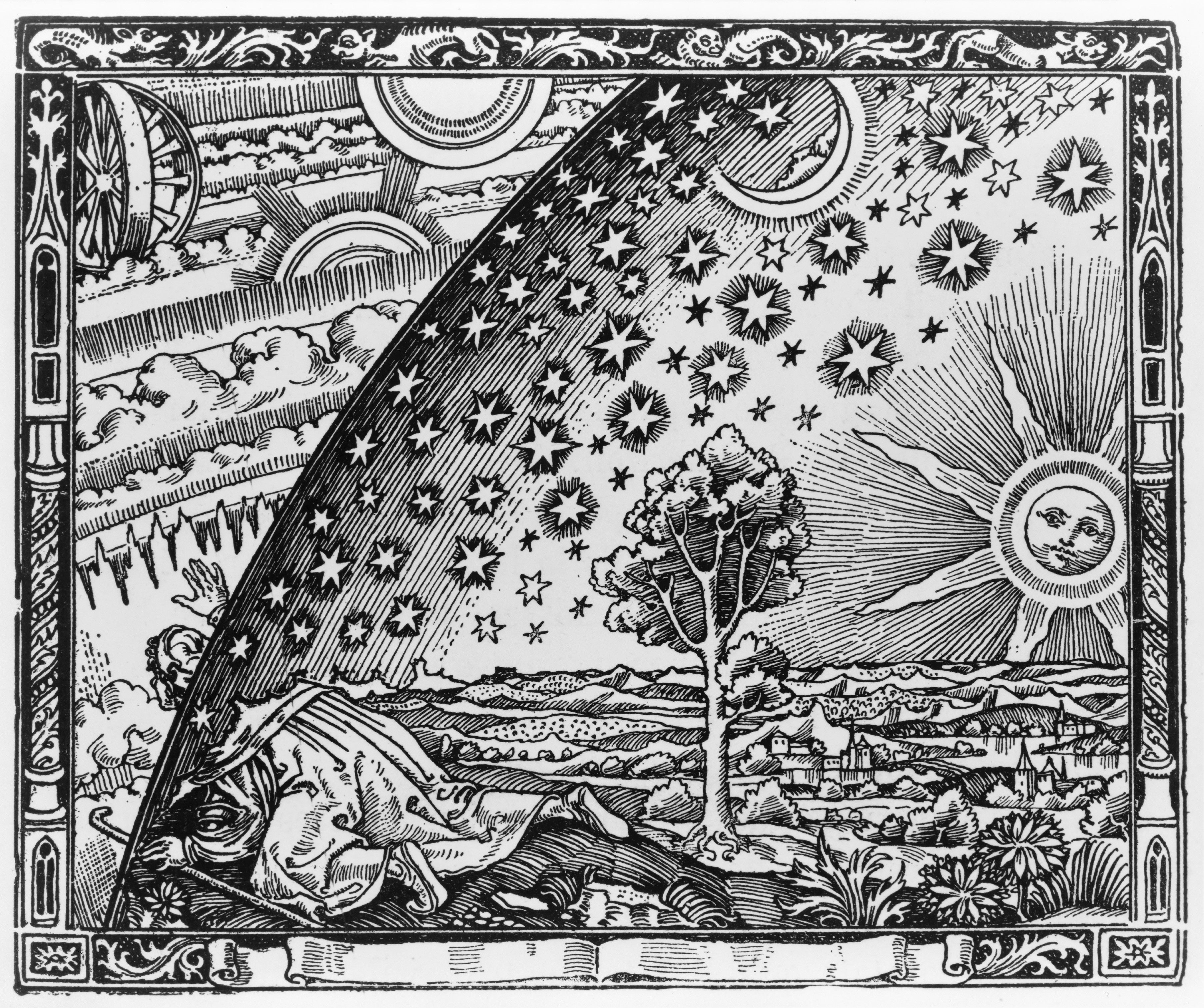
What is Flammarion's Wood Cut Doing Illustrating a CMI Article on Galileo?


Back in October 1997, Russell Grigg published an article on Galileo.

It finishes with, just before the notes, a fact box about the Ptolemaic system.

One could of course ask what such a fact box is doing there, since the Church was in 1616 and 1633 very much not defending the integral Ptolemaic system, but only two of its data in common with other Geocentric and Geostatic systems: 1) Sun moves around Earth daily and 2) moves its daily movement around Earth from South to North and back across Equator yearly.

In fact, the Church was supporting astronomers like Riccioli, who thought that Almagest needed an update badly, because Ptolemy was wrong on so many things, hence the title of Riccioli's work Almagestum Novum. Discoveries by Tycho Brahe and Kepler were taken into account, while two positions (not discoveries) by Kepler were rejected:

  • that Earth moves in a yearly orbit around the Sun and also in a daily rotation around itself*;
  • that the mechanism of movements of celestial bodies is mechanistic.**


But there is another twist to this. Using Flammarion's woodcut when talking of Ptolemaic system is a somewhat dishonest bait and switch tactic. And here is alas what I saw on the article:


Can we get a little close up of the illustration to the right? Here:

A traveller puts his head under the edge of the firmament in the original (1888) printing of the Flammarion engraving.
Anonymous - Camille Flammarion, L'Atmosphère: Météorologie Populaire (Paris, 1888), pp. 163

The Flammarion engraving is a wood engraving by an unknown artist that first appeared in Camille Flammarion's L'atmosphère: météorologie populaire (1888). The image depicts a man crawling under the edge of the sky, depicted as if it were a solid hemisphere, to look at the mysterious Empyrean beyond. The caption underneath the engraving (not shown here) translates to "A medieval missionary tells that he has found the point where heaven and Earth meet..."

Image and captions from:

https://en.wikipedia.org/wiki/Flammarion_engraving#/media/File:Flammarion.jpg


OK, if we go to the mere text in the fact box by Russell Grigg, there is no indication whatsoever that Ptolemaic world view involves a place where heaven and earth meet, like in the wood cut or engraving. Nor any other indication that a Ptolemy reader, believing what he read, would be involved in Flat Earth. Precisely as in the fact text by Flammarion.

In the illustration, however, there is a very clear suggestion that, as there was in Medieval times (it looks like a Medieval wood cut, except it is not clumsy enough***!) a kind of imagination around of a place where heaven and earth met, there was also a kind of imagination that Earth was flat, rather than a globe surrounded by Heaven on all sides. While no actual word, only the fact it is given as illustration of other words, suggests this was a part of Ptolemaic world view, nothing stops the reader (especially the lazy reader, taking things in as a unity) from making the association and actually believing this.

Is Russell Grigg unaware that the original illustration by Flammarion was also given a caption much more directly misleading, one saying basically that the Medievals were willing to believe a Catholic missionary on such detail? If not, and if he is an honest person, rather than as some Ian Paisley creatures willing to twist facts to get at the Catholic Church, why did he include the illustration? Was someone else doing so on the CMI staff?

And if he was not aware of this ulterior dishonesty, even so, why include the wood cut at all, since obviously it was not about the Ptolemaic world view at all?

Was he sentimental about old school books, or did he lose the sense of relevance? I mean, even if he is now one of the older guys on CMI, or even retired, back then he was just 70 years, and people who live to ninety don't tend to be Alzheimer patients, so I can't believe that. However, he could have been a wee bit too faithful to some of the less honest teachers he had met in his childhood or teens or young carreer as a chemist, at university or after.

He is perhaps not the only chemist, who, while learning useful things about chemistry, learned useless things about History of Science.

Hans Georg Lundahl
Nanterre UL
Wednesday of
Pentecost Novena
31.V.2017

Notes:

* Riccioli, like the Church, said probably : definitely wrong - but I have not read that passage, I have not read the whole work. ** Riccioli, in absence of definition by the Church but in presence of a preponderance in favour of angelic movers among writers of the Church considered Kepler probably wrong. That particular passage I have read. I quoted it in this article:

New blog on the kid : What Opinion did Riccioli call the Fourth and Most Common One?
http://nov9blogg9.blogspot.com/2014/08/what-opinion-did-riccioli-call-fourth.html


Written in response to Sungenis and DeLano who while fellow Catholics and fellow Geocentrics were more on Kepler's than on Riccioli's side when it comes to angelic movers.

*** The level of technique in wood cuts shown in this one would be that acquired by the time of the Reformers or even later - after Magellan had settled the issue.

Update:

On Facebook:

Hans-Georg Lundahl
Actually, I just detected a place where Russell Grigg was using a fraudulent or fraudulently placed illustration too: [linking here]

Creation Ministries International
Hans-Georg Lundahl: Links outside of creation.com aren't allowed (our rules on our main Facebook page explain why). You can re-post in fresh thread without the link. As per rule #7, comment hidden.

Hans-Georg Lundahl
My article was my argument fleshed out.

Feel free to just forward it to him.

I have given him an opportunity to respond.


[I was then given and used a good method of forwarding.]

PS : It seems that the article was changed in response to this request. It seems also that the article was changed from a magazine October 1997 to one in September 1997.

mardi 4 avril 2017

Protestant Roots of Old Age / Evolution


Creation vs. Evolution : Protestant Roots of Old Age / Evolution · Φιλολoγικά/Philologica : Cuvier's Analogy and Renaissance Humanism

I was drawn to Russell Grigg's article by the fact that C. S. Lewis was at least for long one of those old earthers and deep timers who were saying everything is getting toward final entropy. He obviously thought souls and even risen bodies could somehow be salvaged from that, but he thought that was what was going to happen.

C. S. Lewis was not mentioned in the article. Three other guys were. Not in the article itself, but in another one it linked to - also Russell Grigg.

CMI : The Future
Some issues for ‘long-age’ Christians
by Russell Grigg
http://creation.com/the-future-some-issues-for-long-age-christians


While it would have been fun to see what C. S. Lewis might have answered on the paradox of a new heaven and a new earth and still the universe "is running irreversibly down" (except that God Almighty can reverse it), we can do with what Russell Grigg had to say on another group of writers, not Inklings.

Since the 1800s—i.e. from the time Lyell, Cuvier, Darwin and others challenged the traditional view that the universe was only thousands of years old—various Christians have tried to harmonize long-age views with biblical beliefs.


Lyell, Cuvier, Darwin ... sounds like two Protestants and a Catholic, right? At least up to apostasies, since Darwin did not remain even Protestant Christian.

Well, sounds like two English and a French, but this does not necessarily mean two Protestants and a Catholic. You see, the Frenchman Cuvier was not a Catholic.

Louis XIV had of course expelled the Calvinists who refused to convert to Catholicism, but he had also conquered Alsatia from Holy Roman Empire (while it was still such). Alsatia included a lot of Lutherans. And the ancestry of "our" Cuvier was of these.

Georges Cuvier - Jean Léopold Nicolas Frédéric Cuvier1, dit Georges (il porte aussi les prénoms de Dagobert et de Chrétien selon les sources)2 Cuvier, né le 23 août 1769 à Montbéliard et mort le 13 mai 1832 à Paris, est un anatomiste français, promoteur de l'anatomie comparée et de la paléontologie au XIXe siècle. ... Né d'une modeste famille luthérienne de Montbéliard, il est le fils de Jean-Georges Cuvier (1715-1795) et de Clémentine Chatel (1736-1792) et le frère ainé de Frédéric Cuvier. Il épouse le 2 février 1804 Anne Marie Sophie Loquet du Trazail (1768-1849), veuve de l'ancien fermier général Duvaucel guillotiné en 1793, dont elle a eu une fille, Sophie Duvaucel (1789-1867), femme de lettres. Du mariage de Georges Cuvier et de Anne Marie Sophie Coquet du Trazail sont nés quatre enfants : trois enfants sont morts en bas âge et la quatrième, Clémentine Cuvier (1809-1827) est morte à l'âge de 18 ans.


Some more on this:

Cuvier was by birth, education, and conviction a devout Lutheran,[16] and remained Protestant throughout his life while regularly attending church services. Despite this, he regarded his personal faith as a private matter; he evidently identified himself with his confessional minority group when he supervised governmental educational programs for Protestants. He also was very active in founding the Parisian Biblical Society in 1818, where he later served as a vice president.[17] From 1822 until his death in 1832, Cuvier was Grand Master of the Protestant Faculties of Theology of the French University.[18]


This Lutheran was also racist:

Cuvier représentait la pensée scientifique dominante en France, en accord avec les préjugés racistes de l'époque, et son influence était grande9.

Dans ce contexte, il a fait des recherches sur les Noirs africains qu'il tenait pour « la plus dégradée des races humaines, dont les formes s'approchent le plus de la brute, et dont l'intelligence ne s'est élevée nulle part au point d'arriver à un gouvernement régulier »18. Peu après la mort de Saartjie Baartman, il entreprit de la disséquer19 au nom du progrès des connaissances humaines. Il réalisa un moulage complet du corps et préleva le squelette ainsi que le cerveau et les organes génitaux qui furent placés dans des bocaux de formol et exposés au Musée de l'Homme20. En 1817, il exposa le résultat de son travail devant l'Académie de médecine. La publication de ses Observations sur le cadavre d'une femme connue à Paris et à Londres sous le nom de Vénus hottentote21 témoigne des théories racistes des scientifiques de l'époque. Il fait notamment allusion à la classification des races humaines par le « squelette de la tête », et à une « loi cruelle qui semble avoir condamné à une éternelle infériorité les races à crâne déprimé et comprimé ». Saartjie Baartman est plus décrite par des traits simiesques que par son appartenance à la race noire : « Notre Boschimane a le museau plus saillant encore que le nègre, la face plus élargie que le calmouque, et les os du nez plus plats que l'un et que l'autre. À ce dernier égard, surtout, je n'ai jamais vu de tête humaine plus semblable aux singes que la sienne »22


This story we find also in the English wiki:

A major anthropological study done by Georges Cuvier was that of Saartjie Baartman. In 1815, Cuvier was a surgeon general to Napoleon Bonaparte. While in this position, the Naturalist received the body of a Khoikhoi woman by the name of Saartje or "Sarah" Baartman. Baartman was a South African immigrant who came to Europe based on the promise that she could become wealthy by displaying her body for Europeans. Based on this promise, Baartman sailed to England where she was treated like a slave and forced to continue displaying her naked body as a curiosity. During these showings, the emphasis was placed on Baartman’s prominent rear end and large sexual organs. In 1814, Baartman was taken to Paris and given to a travelling circus, and where she was subjected to scientific study. One of the scientists who examined her was Cuvier, who developed a fascination with her "ape-like" features.

Baartman died in poverty in 1815 from an unknown inflammatory disease (identified possibly as Syphilis). Her body was sent to Cuvier for scientific observation. Upon receiving the body, Cuvier first made several plaster casts and a wax mold of her body, and then proceeded to dissect her. He removed her skeleton and put it up for display, along with a cast, in the French National Museum of Natural History. Then, he separated her brain and genitals from the rest of her body. These organs were then preserved in jars that were on display for more than 150 years, first in the National Museum of Natural History, and then in the Museum of Man following its establishment in 1937. Her remains and casts were finally taken off display in the late 1970s, following complaints from the public. The display was replaced with one relating Baartman's story in the context of the history of scientific racism.[49][50]


And on his racialism itself:

Cuvier was a Protestant and a believer in monogenism, who held that all men descended from the biblical Adam, although his position usually was confused as polygenist. Some writers who have studied his racial work have dubbed his position as "quasi-polygenist", and most of his racial studies have influenced scientific racialism. Cuvier believed there were three distinct races: the Caucasian (white), Mongolian (yellow), and the Ethiopian (black). Cuvier claimed that Adam and Eve were Caucasian, the original race of mankind. The other two races originated by survivors escaping in different directions after a major catastrophe hit the earth 5,000 years ago, with those survivors then living in complete isolation from each other.[44][45] ... Cuvier's racial studies held the supposed features of polygenism, namely fixity of species; limits on environmental influence; unchanging underlying type; anatomical and cranial measurement differences in races; physical and mental differences between distinct races.[44]


Perhaps there is a reason why Uncle Andrew in The Magician's Nephew is depicted very much like George Cuvier by Pauline Baynes.

Obviously, an article like this cannot find favour with either J. P. Holding or Kent Hovind, they don't consider using the wikipedia as correct documentation.

I kind of think it is, if you use it in two languages and you know both (or if you use one language and come back some weeks later, or if the kind of information is not of a type likely to be filled in by ignorants or deformed by gross misunderstanding or partiality).

I will however not be a total dupe of either wiki or better renowned writers of similar culture to those behind the article.

They try to excuse Cuvier by claiming (or not directly claiming but leaving to be understood) that he was just following Academic standards of his time.

One answer is, wouldn't that be a warning against relying too much on Academic standards of any time, including one's own, that is now (when I am writing it + whenever you will be reading it)? But a more thorough one is, had be been a Catholic obedient to the magisterium, he could not have got away with it. His dissection of Saartjie Baartman would have been impossible if it hadn't been for the fact that the French Revolution humiliated the Catholic Church. His analysis could well have been on the Index Librorum for some time. Alas, I did not find it in the edition of 1949, online.

Earlier however, I think that Isaac de la Pereire (Jew, not Protestant, and then convert to Catholicism) was not just condemned as a writer due to polygenism, but also due to such judgements of "non-Caucasian races."

Hans Georg Lundahl
Nanterre UL
Tuesday after
Ist Passion Sunday
4.IV.2017

mercredi 25 février 2015

Creation Ministries International - a Galileo Fan Club?

1) New blog on the kid : Answering Simcha Fisher, David Palm, Alec Mac Andrew and in part too Sungenis, 2) And CMI also felt a need to "refute Geocentrism" ..., 3) It Seems Keating Wrote a Book, 4) Φιλολoγικά/Philologica : What has that got to do with it?, 5) Were Greek Philosophers Evolutionist? And How Does Geocentrism Conflict with Observation?, 6) HGL's F.B. writings : Debating slightly on CSL with Sungenis, 7) Creation vs. Evolution : Creation Ministries International - a Galileo Fan Club?

A few days ago, I had twice reason to note that.

Yestarday I saw a little gleam of hope.

CMI : Brainwashed! Life in a world of illusion and deceit
By Helen Doogue Vere
Published: 24 February 2015
http://creation.com/brainwashed-life-illusion-deceit


The problem was that, in accepting Galileo’s philosophy that the Bible was about heavenly things and had no relevance to the natural world Christians could start believing that the creation account in Genesis contained gaps or was only symbolic. Once the creation account was called into question, doubts over the global Flood and the Tower of Babel swiftly followed.

Mortenson, T, Philosophical naturalism and the age of the earth: are they related?, The Master’s Seminary Journal 15(1):71–92, Spring 2004


Wow, there is even a link back to 2004:

CMI : Philosophical naturalism and the age of the earth: are they related?
by Terry Mortenson
This paper was published in The Master’s Seminary Journal (TMSJ) 15(1):71–92, Spring 2004
http://creation.com/philosophical-naturalism-and-the-age-of-the-earth-are-they-related


Two important people in the sixteenth century greatly influenced the development of old-earth thinking at the end of the eighteenth and beginning of the nineteenth centuries. Those two were Galileo Galilei and Sir Francis Bacon. As is well known, Galileo (1564–1642) was a proponent of Copernicus’s theory that the earth revolves around the sun, not vice versa. Initially the Roman Catholic Church leadership had no problem with this idea, but for various academic, political and ecclesiastical reasons, in 1633 the pope changed his mind and forced Galileo to recant his belief in heliocentricity on threat of excommunication. But eventually heliocentricity became generally accepted and with that many Christians absorbed two lessons from the so-called ‘Galileo affair.’ One was from a statement of Galileo himself. He wrote, ‘The intention of the Holy Ghost is to teach us how to go to heaven, not how heaven goes.’ In other words, the Bible teaches theology and morality, but not astronomy or science. The other closely related lesson was that the church will make big mistakes if it tries to tell scientists what to believe about the world.

Galileo’s contemporary in England, Francis Bacon (1561–1626), was a politician and philosopher who significantly influenced the development of modern science. He emphasized observation and experimentation as the best method for gaining true knowledge about the world. He also insisted that theory should be built only on the foundation of a wealth of carefully collected data. But although Bacon wrote explicitly of his belief in a recent, literal six-day creation, he like Galileo insisted on not mixing the study of what he called the two books of God: creation and the Scriptures. He stated,

But some of the moderns, however, have indulged in this folly, with such consummate carelessness, as to have endeavoured to found a natural philosophy on the first chapter of Genesis, the book of Job, and other passages of holy Scripture—‘seeking the dead among the living.’ And this folly is the more to be prevented and restrained, because, from the unsound admixture of things divine and human, there arises not merely a fantastic philosophy, but also a heretical religion.


As a result of the powerful influence of Galileo and Bacon, a strong bifurcation developed between the interpretation of creation (which became the task of scientists) and the interpretation of Scripture (which is the work of theologians and pastors).

Notes from section:
3 Galileo, Letter to the Grand Duchess Christina (1615), translated and reprinted in Stillman Drake, Discoveries and Opinions of Galileo, Doubleday, New York, p. 186, 1957 , reprinted in D. C. Goodman, ed., Science and Religious Belief 1600-1900: A Selection of Primary Sources, The Open University Press, Milton Keynes, U.K., p. 34, 1973.
4 Much has been written about this complex Galileo affair. Helpful analyses can be found in Thomas Schirrmacher, The Galileo Affair: history or heroic hagiography? TJ 14(1):91–100, 2000, and in William R. Shea, Galileo and the Church, in God and Nature, eds. David C. Lindberg and Ronald L. Numbers, University of California Press, Berkeley, California, pp. 114–35, 1986. (Not endorsing Schirrmacher)
5 Francis Bacon, The Works of Francis Bacon, London, 2:480–88, 1819.
6 - for the quote - Francis Bacon, translated by Andrew Johnson from the 1620 original Novum Organum, London, p. 43, 1859 (Book I, part lxv). See also Francis Bacon, Advancement of Learning, Oxford, p. 46, 1906 (Book I, part VI.16).


In other words, one might be starting to get somewhere with asking oneself if Galileo was wrong and the Church was right.

Today republishing an article by Russell Grigg is obviously trying to "undo the damage".

CMI : ‘Nevertheless, it moves!’: Copernicus, Galileo, and the theory of evolution
By Russell Grigg [specified it is a republish, but not from when, except after 1978]
http://creation.com/copernicus-galileo-evolution


The Church fathers of the Middle Ages, in the absence of any substantial scientific views to the contrary, adopted and taught as dogma the theory of Ptolemy of Alexandria (ad 85–165) that the earth was the centre of the universe, and that the sun, moon, planets, and stars all revolved around the earth in a series of inter-nesting spheres.


Patristic era is from end of Apostolic era (i e since St John left earthly life) to c. 1000. After that you get a scholastic era. Scholastics and Church Fathers are usually distinguished. Orthodox would usually claim that they share (most of) the Church Fathers previous to 1000 (not the Franks, perhaps) - while standing off from the Scholastics.

Ptolemaic system involves Earth being round and astronomic distances being so great that Earth in comparison to them is just like a spot - some Church Fathers took an opposite view (shared thus with Rabbinic Judaism) that Earth is one flat storey in a box shaped universe with Heaven above and Abyss below. And perhaps also that distance to Stellar parts of Heaven or even God's throne room above that was kind of comparable to distances on Earth. Scholastics never adopted the Ptolemaic system to the total exclusion of other explanations of orbits.

Although the Bible is not specific about which revolves around what, the Latin fathers thought that verses such as Psalms 19:6 and 93:1 supported Ptolemy’s views.


When it came to Earth being still and to Heaven and Sun moving.

Galileo in his eagerness to explain full compatibility with Scripture (as history) of his theory would drag in Joshua X - which drastically altered acceptability of heliocentrism. As he was to find out.

Although he had no telescope, he concluded from his visual observations and calculations that the earth was not the centre of the universe but only of the moon’s orbit, that the earth rotated daily on its axis, and that it revolved annually around the sun.


No, he concluded that this would give a simpler geometry for the orbits and make them more foreseeable than Ptolemy did. He did not dare to say in public that these hypotheses really were so.

Note on the "correcting tables note" that the Heliocentric Copernicus corrected tables of Ptolemy (or of such Ptolemaic astronomers as had been around), but Tycho Brahe who was a Geocentric (with a not quite Ptolemaic system) corrected those of Copernicus, and Kepler who was again a Heliocentric corrected those of Tycho Brahe. And Riccioli accepted Kepler's corrections, but not his Heliocentrism.

[Galileo Galilei] ... improved the simple telescope by building an instrument of threefold magnification, and further quickly improved it to a power of 32. With this he observed (inter alia) the movement of sunspots across the face of the sun. This, he maintained, proved that Copernicus was right and Ptolemy wrong.


Nobody in the Church had any problem of admitting Ptolemy was wrong on some items. But the question is if that proved Copernicus right.

In 1616, Galileo was ordered by Cardinal Robert Bellarmine, the chief theologian of the Church, that he must henceforth neither “hold nor defend” this doctrine, although it could still be discussed as a mere “mathematical supposition”.


There is no such position as "chief theologian". The Pope is the chief judge on theology, but not the chief theologian. However, St Robert was a Cardinal (a position next under Pope, but there are several such at any given time), he was an Inquisitor and he had tried the first book of Galileo (in 1616 Galileo wasn't tried yet, his first book was). St Robert died in 1621. The next trial, it was Galileo himself who was being tried and St Robert was not around.

However, he had done a lot of the scientific and philosophic groundwork for the second trial.

Among other things he had ordered the fellow Jesuit Clavius to look into the telescope and thus he got most observations of Galileo's confirmed. One was not: Clavius concluded about the Milky Way that yes, there were lots of stars in it, but there was a view of sth powdery still in the telescope not dissolved into stars - and that remains so with modern astronomy having much better telescopes.

For this he was hauled before the Inquisition in Rome on “vehement suspicion of heresy”. He was found guilty of having “held and taught” the Copernican doctrine and, on June 21, 1633, was ordered to recant. The next day he recited a formula in which he “abjured, cursed and detested” his past errors. His sentence carried imprisonment, but this was immediately commuted by the Pope to house-arrest, which remained in effect for the last eight years of his life.


Was there really a distinct prison sentence before a house arrest commutation? I thought the then word "prison" / "praehensio" meant house arrest, while "immuration" / "immuratio" meant a walled prison, what we think of as a prison. But I could be wrong. That might have been earlier, like 13th C. in which lots of not quite finally condemned heretics were condemned to "immuration" (i e prison) until they could either in good conscience abjure or in the good conscience of the Inquisitors be extradicted to secular arm. Or Galileo could, unknown to me, have had a first sentence running on immuration - but that seems unlikely, since he had abjured. Meaning, I think Russell Grigg is wrong in taking the house arrest as a commuted sentence.

Now Russell Grigg made three comparisons, which I will look at in some detail.

The first one is this quote:

The Church of Galileo’s day was a monolithic structure in which there were no men of science of the calibre of Copernicus or Galileo in positions of authority. Today the Church is made up of many different denominations, comprising many different congregations, in which there are many men and women of science in positions of leadership or influence, who hold to the creationist position and whose scholarship is not one whit less than that of any evolutionist.


The Catholic Church of Galileo's day was condemning the already then extant Protestant denominations. St Robert Bellarmine had had a debate rather prolonged with James VI & I of Scotland and England.

It was not monolithic. If the men in highest authority were not men of science in the sense of being of Galileo's calibre it is rather that they were a bit too professional, they were not so amateurish. But as Copernic shows, there was room for amateurism on lower levels. That said, science as such was amateurish rather than a profession mimicking the episcopal structure of the Church.

It is a bit as if Russell was unaware that his own denomination was outside the Catholic Church. Whether it existed itself or only in its predecessors already separate from Catholicism, it was distinct. The many different denominations were there. A few decades later Bishop Bossuet of Meaux taunted the Calvinists and Anglicans with Protestantism already being split into about 100 denominations.

[T]here are many men and women of science in positions of leadership or influence, who hold to the creationist position and whose scholarship is not one whit less than that of any evolutionist.


That is exactly how I would describe St Robert and Clavius and Riccioli back then. Just exchanging heliocentric for the word evolutionist.

Second comparison, first quoting:

Galileo, by using his telescope to view the sunspots and to track the motion of the planets with respect to the sun, was able to do repeatable experiments of observation to confirm the Copernican theory. Today, there is no experiment that any evolutionist has ever done (much less a repeatable one) either to observe or to confirm the theory of evolution.


Galileo had infirmed details of Ptolemy's world view. All supralunar bodies are perfect? Galileo showed sun spots. Immutable? Galileo showed the sunspots moving (and Tycho Brahe observed a nova). No body is direct centre of an orbit except earth? Or you can have only two but not three circular movements around each other with a centre moving around a periphery? Galileo showed four moons of Jupiter. Sun moves around Earth. Jupiter around Sun (and not just around a void centre moving in orbit around Earth). Moons of Jupiter around Jupiter (and thus a third degree of circling movement).

Now, Galileo was never told to retract Moons of Jupiter or Spots on the Sun. He was told in good scientific discourse by the Tychonian St Robert Bellarmine that these do not prove Earth to be moving or Sun to be still.

Today, there is no experiment that any evolutionist has ever done (much less a repeatable one) either to observe or to confirm the theory of evolution.


What about Miller Urey? Hasn't it shown amino-acids can form abiotically? Yes, but as CMI time after time has pointed out, this neither proves cell structure can have originated that way, nor that the DNA code could have done so. And C14 measures and K-Ar measures don't prove ages older than creation? No, they don't. BUT in that case one could ask whether any repeatable experiment has since those days proven either Earth's rotation or Earth's orbit. I have looked into the question - such conclusions suffer from very similar problems of logic.

Put another way: the matter of the earth’s motion was in principle capable of test by the scientific method in terms of settling the question once and for all


OK, have you observed Earth zigzagging from space missions? Or have the space missions been observed zigzagging from Earth? That would suggest that Earth were moving in and out of origo of the trajectories of them ... but if space is a medium even that is not a sure conclusion and on top of that finding confirmation for such an observation having taken place is somewhat difficult:

Catholic Answers Forums > Forums > Apologetics
Has Cassini-Huygens spacecraft earth flyby in 1999 disproven geocentrism
http://forums.catholic.com/showthread.php?p=9120534#post9120534


Since Didymus means Thomas, I wonder if this is Tom Trinko ... but after I was banned from the forum I tried to find confirmation for such an observation again:

Correspondence of Hans Georg Lundahl : Asking an Erudite for Optical Proof
http://correspondentia-ioannis-georgii.blogspot.com/2014/09/asking-erudite-for-optical-proof.html


today the origins issue is in principle not capable of being so resolved. As Dr Henry Morris says in his book Scientific Creationism: “A scientific investigator, be he ever so resourceful and brilliant, can neither observe nor repeat origins!”


On the exact same note : we cannot observe Earth and Sun from the edge of the universe. If we have a firm place within, it is earth and sun and universe up to stars is shown moving. If it isn't earth, we have none, and earth cannot be shown to be moving, even if it is.

Third comparison:

Although the Church fathers in Galileo’s day mistakenly thought that the Bible supported a geocentric system, there was nothing intrinsically atheistic about the notion that the earth moved. By contrast, the theory of evolution is a non-theistic or atheistic explanation of origins and as such has become the scientific ‘justification’ for the anti-God belief system of humanism, which pervades society today.


Heliocentrism also if contrasted with the Geocentrism of St Thomas. Riccioli is abandoning the thesis that God moves all Heaven (meaning he is beginning to accept space as a void) because he saw on example of Epicurus one could be a Geocentric believing Heaven moved around earth and yet be an Atheist - but Epicure showed a very unsubtle grasp of essentially Ptolamaic Geocentrism - there are so many details in it, even more in Tychonian one, that show design.

Christians who believe in evolution would do well to consider that while not every evolutionist is an atheist, all atheists are evolutionists.


And how many of them are Thomistic and Tychonian Geocentrics? How many Atheists believe Cosmos is moved each day by one great and wise power around Earth? How many Atheists believe that angels regulate slower movements of heavenly bodies in relation to this daily movement?

All Atheists are Heliocentrics or Acentrics.

As with all erroneous theories, there were some things that the Ptolemaic system did not explain, such as the apparent backwards-and-forwards motion of Mars across the sky.


Except that Ptolemy did explain it.

To account for this and other anomalies the geocentric astronomers invented a complex system of planetary movement involving large circles called deferents and small circles called epicycles.


Tychonian Geocentrism makes Sun = epicentre for all planets except Sun itself and Moon. With Earth not a planet, nor stars, obviosly.

By the sixteenth century, this system had become so vast and fantastically involved that Copernicus wrote in the Preface to De Revolutionibus that the astronomical tradition that he inherited had finally created a monster.


I read somewhere the system had about twice as many circular movements as Copernicus' own system, how about checking it out? For the moment I can't.

But the comment itself shows how Copernicus wanted an easy visualisation to accept a concept. Yes, Tychonian orbits are less obviously regular and simple than Galilean ones. So?

Copernicus acted like a Renaissance non-scientist who rejected the Medieval science because it was conceptually too complex - but in his case, the Ptolemaic astronomy was only geometrically too complex to visualise.

Yet so ingrained had the idea become that the earth was the centre of the universe that hardly any of the astronomers of the day heeded the growing unreality and impossibility of the whole system.


If angels are moving each orbit and God is moving day and night carrying all the orbits with them, where do you find any actual "impossibility"? We are not required to be able to draw everything which we believe happens. And even Tychonian orbits can be drawn by a good artist with lots of patience - or by a computer programme.

In other words, though I agree that the lesson of the affair is we should oppose Evolution, I think it was provided by St Robert Bellarmine's opposition to Galilean Heliocentrism, not by Galileo's beating the Ptolemaic dead horse, since Geocentrics in his day (unless backward and illinformed) were already Tychonian or even like Riccioli accepting Kepler's variations on Tycho - excepting the demotion of Earth to higher spheres.

It is instructive to see the non-Theological qualifications of the three CMI writers. Theologically all three were when writing Protestants, which is a disqualification, but not for every question. Tas Walker is a Protestant, I'll trust him over Teilhard de Chardin any day of the week. But when it comes to the non-Theologic qualifications, who of the three should be speaking about the Galileo affair?


Helen has a Bachelor of Arts in English Letters. Presumably including early modern period, which is in some part concerned with when the question was a piece of debate rather than a set piece of school knowledge. Terry has at least done some history of a science, and as geology is a young one, one may even hope it is conducted in a more exact way than history of mathematics or history of science in general. For Russell, I see nothing which corresponds to that. I mean him no disrespect in chemistry, I would gladly submit my doubts about measurability of half lives of isotopes having longer ones than C14 to him, but history of ideas is really not his academic field. Or close to it. And his essay doesn't convince me of a very good amateur in it either.

Hans Georg Lundahl
Nanterre UL
Day after St Matthias
25-II-2015

PS: Can this "his sentence carried imprisonment, but this was immediately commuted by the Pope to house-arrest, which remained in effect for the last eight years of his life" simply have arisen due to Milton saying he visited Galileo "who was prisoner of the Inquisition"? That would certainly refer to the house arrest, since prison was a word currently so used.

mardi 2 décembre 2014

CMI on Galileo again (not their most honest topic!)

It is actually a small paragraph from them* and then a paragraph from Peter Harrisson quoted by them which I will focus on. The rest of today's article is decent.

So what are the facts? With his telescope, Galileo carried out repeatable observations which refuted the geocentric (earth-centred) systems of Aristotle and Ptolemy, and extended the heliocentric (sun-centred) system of Copernicus. He observed that the sun had spots which moved across its surface, showing that the sun was not ‘perfect’ and that it rotated; he observed the phases of Venus, showing that Venus must orbit the sun; and he discovered four moons that revolve around Jupiter, not the Earth, showing that the Earth was not the centre of everything. He also observed three comets pass effortlessly through Ptolemy’s ‘crystalline spheres’ (in which the planets and stars supposedly moved around the Earth), showing that these spheres must be imaginary.


Bit by bit now:

With his telescope, Galileo carried out repeatable observations

Yes.

which refuted the geocentric (earth-centred) systems of Aristotle and Ptolemy,

but not the equally geocentric system of Tycho Brahe

and extended the heliocentric (sun-centred) system of Copernicus.

or the geocentric system of Tycho Brahe.

He observed that the sun had spots which moved across its surface, showing that the sun was not ‘perfect’ and that it rotated;

which was not condemned

and he observed the phases of Venus, showing that Venus must orbit the sun;

which was not condemned, and which is part of Tycho Brahe's system

and he discovered four moons that revolve around Jupiter, not the Earth,

which was not condemned

showing that the Earth was not the centre of everything.

... not the DIRECT centre of everything.

He also observed three comets pass effortlessly through Ptolemy’s ‘crystalline spheres’ (in which the planets and stars supposedly moved around the Earth), showing that these spheres must be imaginary.

Or aethereal. Either way, that observation also was not condemned. In fact none of his direct observations and none of their strictly logical conclusions were condemned.


Here is a quote from Peter Harrisson through CMI today:

Peter Harrison (Prof. of Science and Religion, University of Oxford) correctly refutes this disinformation, saying it was “a conflict between two sciences; a conflict between traditional Aristotelian science and a new science that Galileo is proposing. … Catholicism reacts because its authority is under threat, but that’s not a question to do with science and religion; it’s a question to do with the politics and authority.”


a conflict between two sciences;

between three actually: Galileo took account of his own and of Ptolemaic Aristotelians. He took no account of Tycho Brahe.

a conflict between traditional Aristotelian science and a new science that Galileo is proposing.

Peter Harrisson no doubt has Galileo among his scientific heros and read the conflict through Galileo's pen. So did Chaberlot, basically, though he provides information of other points as well.


What exactly is left out here?

Catholicism reacts because its authority is under threat, but that’s not a question to do with science and religion; it’s a question to do with the politics and authority.

That is an assessment, not a piece of factual information no one could think otherwise about.


The "authority of the Catholic Church" involves, as per Trent:

  • Inerrancy of all Scripture in each passage, at least as per original (translations used by Church can contain factual errors only if not doctrinal, say whether Vulgate is better or worse than Septuagint for dating the age of Heaven and Earth - but if translation x differs from original, it would stand to reason the matters are small and correctable from other versions).
  • Inerrancy of, not each single Church Father, but all Church Fathers taken together when unanimous on a matter.


But it is very possible Peter Harrison regards neither (outside religious topics) as "religion". I am not even sure he regarded the hasty conclusions of Galileo as science. Chaberlot named "six arguments" from Galileo and "six proofs" available later for Heliocentrism (I refuted all twelve, but that is in French).

It would be very wrong to say all Church Fathers had supported Aristotle or all had supported Ptolemy in every detail.

Someone wanted to ridicule Church Fathers on a forum and called in how such and such one had believed in Crystalline spheres. On that forum, I replied "sure, I'll believe that too, if all Church Fathers are unanimous on it." They are not. The ones that supported a Hebraising, flat Earth containing (but not exclusively defined by that) cosmology were believing each star and planet and sun and moon went as the body we see through basically empty space. Neither aether (which I support, see Coriolis) nor crystalline spheres for those ones. Hence, crystalline spheres can be attacked without attacking the authority of the Catholic Church.

But CMI continues lying (or at best repeating lies, but I have tried to point it out!) in its nearly Masonic reverence for Galileo.

Scientific establishment attacked Galileo and Church supported it?

What exact Scientific establishment? Sure, universities existed, but unlike Evolutionist quasi consensus now, debates existed too.

Picked on a few verses like Psalm 103:5?

How many times is it now that they neglect to mention the Joshua 10:13 verse which was very much up to a debate between Galileo and St Robert Bellarmine in the 1616 process against a book of his? They systematically explain the verse - when they mention it as if it were just any inquiry, and as if it had no relation to Galileo case - according to Galileo's and against St Robert Bellarmine's understanding of it. They also fail to mention that St Robert Bellarmine fully understood the position of Galileo and gave a refutation of it: "if Earth had stopped turning around itself, only, then Moon would have continued, since not tied to Earth". Their writer John Gideon Hartnett recently was on a forum from which I was excluded where I was repeatedly asked what my favourite verse was while I had made it clear alreay it was Joshua 10:12 (Joshua adressed no word at all to Earth, so we cannot suppose it was Earth that changed behaviour).

HGL's F.B. writings : How I answered Mike P with Scripture on Catholicism
http://hglsfbwritings.blogspot.com/2014/11/how-i-answered-mike-p-with-scripture-on.html


Note how SDA female pastor Lea misses I have already answered what my verse is.

On this series 5 - 7 were on that forum and 5 - 8 were on topic of Joshua 10:12, here:

1) Assorted retorts: ... on Not Believing Vedic Astronomy Apart from Geocentrism, on Believing Scholastic Astronomy Including Geocentrism, 2) ... on Nicole d'Oresme refusing to apply relativity perfectly understood to Geocentric appearances, 3) ... on Black Holes and Geocentrism, 4) Back to Godinci, 5) HGL's F.B. writings: A "Biblical" Heliocentric Misciting Holy Scripture, 6) Vy considers I accused him falsely of mis-citing the Bible, Rod invokes relativity, 7) Vy makes his point more clearly - so do I, 8) New blog on the kid : Columbus and Joshua (Imagine Christopher Columbus had worked a miracle)


After I had been provoked to defend Catholicism on that forum (YE3C - Astronomy on FB), and had also mentioned my take on what Joshua 10:12 involves and defended it before that, I was banned and Alex Naszados informed another forum (Catholic Cosmology and Geocentrism) that debates involving Geocentrism were for the future banned on the forum where Mike P (SDA, self-employed lawyer, according to profile, I know his last name but abbreviate, since he is not a public figure that I know of).

What CMI is suggesting is that these Creationist astronomers were ONLY being as fixed on one position as the Scientific Establishment of Galileo's time. Not so.

And of course, it was Galileo himself with his heterodox understanding of the Joshua passage, which alerted the Church he was contradicting the Bible. A Dominican prior of San Marco struck the alarm bell on that very occasion. One more thing in Galileo: he refuted Ptolemy on a few points, no problem, but not only did he not refute the Geocentric position of Aristotelians, he did not even refute their "physics of astronomy". As I recently dealt with elsewhere on my blogs.**

Hans Georg Lundahl
Nanterre University Library***
St Bibiana
2-XII-2014

* Exploring the God Question: 1. The Cosmos, Part 1 (The big bang)
by Russell Grigg, Published: 2 December 2014
http://creation.com/exploring-cosmos-big-bang


** Φιλολoγικά/Philologica : Kurukshetra War and Joshua's Long Day
http://filolohika.blogspot.com/2014/11/kurukshetra-war-and-joshuas-long-day.html


*** Will see if their hospitality extends to a coffee or even a slight lunch today ...